It is such a shame that as yet, the Governments various intertwining bodies do not join up in sharing information.
The Data Protection Act, much like Health and Safety advice can be taken to strictly, resulting in little or no information being shared when it would actually benefit the customer.
An example for us is our accounts. We are a registered charity (England and Wales) so our accounts have to be submitted to the Charity Commission. Our legal framework is a company limited by guarantee (no share capital) so we also have to submit the same accounts to Companies House. In addition, because it is a company (in name) the same accounts also have to be submitted to HM Revenue and Customs.
Each has their own way of doing it.
For the Charity Commission will simply log on and upload a pdf file of the accounts, which over time will then appear on our listing on their web site.
For Companies House the accounts can again be submitted online, though in our case our accountant is sending them direct.
HMRC need the accounts sent as well, and again they can be done online or by post.
What a shame that it cannot be sent to one of them, and the information shared to interested parties.
Of a more frustrating concern is that HMRC does not accept the charity being registered with the Charity Commission as proof it is actually a charity. So we have to complete a form of dozen pages, send them the same Memorandum and Articles of Association that were also sent to both the Commission and Companies House, a copy of our accounts (ditto), and examples of our charitable activities. They then decide whether we charitable and can claim Gift Aid.
I understand both the tax code and the Charity Commission are reviewing practices, but I guess it would somewhat stretching it to believe that joined-up government would come from this.

Monday, 4 October 2010

Sunday, 12 September 2010
GuideStar listing
If you require further information about the charity we have updated our free listing on the GuideStar.org.uk web site.
Thursday, 2 September 2010
What a fantastic month of new homes!
August was a brilliant month for Happy Staffie Rescue.
During those 31 days our small charity was able to successfully rehome eight stray or unwanted Staffordshire bull terriers, arguably one of the most difficult dog to rehome.
It gives a tremendous sense of achievement but no pride, because as eight go out, there is always another eight waiting to come in.
However we can but wonder why some other rescues with much larger resources and with fewer Staffies in their care can struggle to rehome even one.
These wonderful dogs deserve the best of second chances and our brilliant team of volunteers have delivered a super month for Happy Staffie Rescue.
During those 31 days our small charity was able to successfully rehome eight stray or unwanted Staffordshire bull terriers, arguably one of the most difficult dog to rehome.
It gives a tremendous sense of achievement but no pride, because as eight go out, there is always another eight waiting to come in.
However we can but wonder why some other rescues with much larger resources and with fewer Staffies in their care can struggle to rehome even one.
These wonderful dogs deserve the best of second chances and our brilliant team of volunteers have delivered a super month for Happy Staffie Rescue.
Friday, 30 July 2010
Independent Examination complete
The independent examination of the accounts (as required by law) have been completed by our accountants and the final accounts and report for 2009-10 is now complete.
Now that was a journey.
My continued thanks to Tim Pearce and Crump Pearce & Co. for his advice and help.
Now that was a journey.
My continued thanks to Tim Pearce and Crump Pearce & Co. for his advice and help.
Saturday, 3 July 2010
Stourbridge opens its doors
Our second charity has opened its door after Mark led a team of volunteers at breakneck pace to fit the shop out to our standards.
Well done to Mark and his many friends and family, the valued volunteers of Happy Staffie Rescue.
The success of Stourbridge will allow more funds to be put towards the welfare of dogs, part of our long term strategy to have sufficient income to have our own rehoming centre in the future.
Well done to Mark and his many friends and family, the valued volunteers of Happy Staffie Rescue.
The success of Stourbridge will allow more funds to be put towards the welfare of dogs, part of our long term strategy to have sufficient income to have our own rehoming centre in the future.
Tuesday, 15 June 2010
We're moving forward - our next charity shop is required
Even before the ink is dry on the completion of the lease for our second charity shop we are searching for the next location for a successful Happy Staffie Rescue charity shop.
Our first charity shop has provided invaluable income for the charity during the course of the last ten months. It is a model we hope to replicate in Stourbridge.
If successful Stourbridge will lead us directly into our third charity shop. Time, funds and the availability of our people to offer their services in their own time and entirely voluntarily will determine whether our third charity shop occurs in the calendar year.
Our aim, if all goes to plan is to open the third shop before the end of September. This is an incredibly tight schedule considering that no site has yet been found. Negotiations can drag on for weeks on end but if we find the right property we will pursue it as swiftly as is reasonable.
Ideally we would like to move into Bromsgrove next. We have good support from within the town and it is an appropriate geographical location from our base in Kidderminster.
Our first charity shop has provided invaluable income for the charity during the course of the last ten months. It is a model we hope to replicate in Stourbridge.
If successful Stourbridge will lead us directly into our third charity shop. Time, funds and the availability of our people to offer their services in their own time and entirely voluntarily will determine whether our third charity shop occurs in the calendar year.
Our aim, if all goes to plan is to open the third shop before the end of September. This is an incredibly tight schedule considering that no site has yet been found. Negotiations can drag on for weeks on end but if we find the right property we will pursue it as swiftly as is reasonable.
Ideally we would like to move into Bromsgrove next. We have good support from within the town and it is an appropriate geographical location from our base in Kidderminster.
2nd charity shop
We have completed our lease for our second charity shop.
The new charity shop will be located at No.7 Market Street, Stourbridge.
We are due to obtain the keys tomorrow and Mark will begin the intense process of fitting the shop out over the next couple of weeks.
Mark is an asset to the charity not least for his enormous retail experience up to various management positions and of course is years of voluntary charity work. His knowledge is essential in this process as he sources the fixtures and fittings required and builds the interior according to his own design and specifications.
Together we are working to ensure that this process is completed for the least amount of money possible and have already sourced products from four separate specialist suppliers to obtain the best value for the charity.
At this early stage we have a target date of 3 July 2010 as our opening. Whether we go for a soft opening before this will depend on the work required to build the shop.
The new charity shop will be located at No.7 Market Street, Stourbridge.
We are due to obtain the keys tomorrow and Mark will begin the intense process of fitting the shop out over the next couple of weeks.
Mark is an asset to the charity not least for his enormous retail experience up to various management positions and of course is years of voluntary charity work. His knowledge is essential in this process as he sources the fixtures and fittings required and builds the interior according to his own design and specifications.
Together we are working to ensure that this process is completed for the least amount of money possible and have already sourced products from four separate specialist suppliers to obtain the best value for the charity.
At this early stage we have a target date of 3 July 2010 as our opening. Whether we go for a soft opening before this will depend on the work required to build the shop.
Friday, 4 June 2010
Charitable Incorporated Organisation
A new format for forming and running a charity could become a reality in 2011 - the Charitable Incorporated Organisation.
This new format gives charities the security of a legal entity while removing the duplication of the reporting requirements of Companies House. This in theory should cut administration and accounting costs.
However, this is yet to be passed through Parliament and with a new Government with what is almost certain to be a busy parliamentary period the chances of the CIO seeing the light of day could be slim.
When I first of the CIO I thought it was a wise idea, simply for removing the reporting requirement to Companies House. However there is the very real concern over whether the CIO will be quickly recognised as the entity it is. CIO's will still be registered charities, but they will be a "CIO" and this might deter some people. It will be particularly problematic for those charities that sources funds from overseas where the CIO entity will be unknown.
While moving the framework of the charity from a company limited by guarantee (no share capital) to a Charitable Incorporated Organisation is very appealing, the manner in which it has to be undertaken is not. To move from one to the other the registered charity cannot simply fill a form in or press a button. They have to register the new CIO, then wind up the existing company and transfer all the assets to the CIO. For amateurs and volunteers such as ourselves this might be a bridge too far. We could probably engage an accountant or a solicitor to do the work for us, but at what cost?
Time will tell whether the CIO does become a reality and at that time we will consider long and hard over the long term benefits of moving to the new structure.
This new format gives charities the security of a legal entity while removing the duplication of the reporting requirements of Companies House. This in theory should cut administration and accounting costs.
However, this is yet to be passed through Parliament and with a new Government with what is almost certain to be a busy parliamentary period the chances of the CIO seeing the light of day could be slim.
When I first of the CIO I thought it was a wise idea, simply for removing the reporting requirement to Companies House. However there is the very real concern over whether the CIO will be quickly recognised as the entity it is. CIO's will still be registered charities, but they will be a "CIO" and this might deter some people. It will be particularly problematic for those charities that sources funds from overseas where the CIO entity will be unknown.
While moving the framework of the charity from a company limited by guarantee (no share capital) to a Charitable Incorporated Organisation is very appealing, the manner in which it has to be undertaken is not. To move from one to the other the registered charity cannot simply fill a form in or press a button. They have to register the new CIO, then wind up the existing company and transfer all the assets to the CIO. For amateurs and volunteers such as ourselves this might be a bridge too far. We could probably engage an accountant or a solicitor to do the work for us, but at what cost?
Time will tell whether the CIO does become a reality and at that time we will consider long and hard over the long term benefits of moving to the new structure.
Learning the ropes of bookkeeping
There are many learning curves to be navigated with setting up and running a charity for the first time. We chose the company framework at the outset because of the benefits this provided for securing contracts, leases, employing staff, etc as well as providing a legal identity in its own right.
The complication for this is the reporting requirements to both Companies House and the Charity Commission. This means the accounts have to be submitted twice.
That said I have to raise my hat to Tim Pearce at Crump Pearce & Co., our accountants. Their reassuring, down to earth and approachable manner has helped us put our first year accounts together. Their advice has been invaluable and I would not hesitate to recommend their services. Their insight has helped shape the format of my books for the 2010/11 accounting period, which despite my earlier concern actually makes them far easier to work through and understand making the analysis far easier to see.
The complication for this is the reporting requirements to both Companies House and the Charity Commission. This means the accounts have to be submitted twice.
That said I have to raise my hat to Tim Pearce at Crump Pearce & Co., our accountants. Their reassuring, down to earth and approachable manner has helped us put our first year accounts together. Their advice has been invaluable and I would not hesitate to recommend their services. Their insight has helped shape the format of my books for the 2010/11 accounting period, which despite my earlier concern actually makes them far easier to work through and understand making the analysis far easier to see.
Second shop approaching...
After a protracted period of negotiations, a period when all bets were off, the negotiations for our second shop are finally nearing conclusion.
What has compounded our attempt to open this shop is mainly the fact that volunteers can only do their thing (me included) when we're not at work, and when we're not at work is usually when those people who need to speak are also not at work. Needless to say this means an e-mail can take 24 hours to reply to, or phone messages a similar time to respond.
This manner of negotiation while having some advantages also can cause confusion. Every lease we negotiate gives us more experience for the next, and there will be more. Our medium term plan is to open several charity shops as these provide a degree of stable income. The retail side of the charity is also linked to our long-term aim of our own kennels which will take a considerable length of time to become a reality.
As of today final terms seem to have been agreed, a schedule of ingoing condition has been prepared and we not await the final go-ahead from the landlord. Obviously all this is still subject to final lease as it has yet to be presented with the last amendments in place. That said, we hope to be signing the lease during the first half of June.
What has compounded our attempt to open this shop is mainly the fact that volunteers can only do their thing (me included) when we're not at work, and when we're not at work is usually when those people who need to speak are also not at work. Needless to say this means an e-mail can take 24 hours to reply to, or phone messages a similar time to respond.
This manner of negotiation while having some advantages also can cause confusion. Every lease we negotiate gives us more experience for the next, and there will be more. Our medium term plan is to open several charity shops as these provide a degree of stable income. The retail side of the charity is also linked to our long-term aim of our own kennels which will take a considerable length of time to become a reality.
As of today final terms seem to have been agreed, a schedule of ingoing condition has been prepared and we not await the final go-ahead from the landlord. Obviously all this is still subject to final lease as it has yet to be presented with the last amendments in place. That said, we hope to be signing the lease during the first half of June.
Sunday, 18 April 2010
Dog Show, Sunday 9 May 2010
Happy Staffie Rescue will be holding a companion Dog Show on Sunday 9 May 2010 in conjunction with Birch Hill Dog Rescue.
The Dog Show is open to all breeds and will be held under Kennel Club rules and show regulations.
There is also a novelty ring and a ring for Staffordshire bull terriers judged by the President of the Staffordshire Bull Terrier Club.
The event will be held at Riverside Meadow, Stourport on Severn.
Entries can be registered from 10am and we hope to get under way at 11am.
For more information please click here.
The Dog Show is open to all breeds and will be held under Kennel Club rules and show regulations.
There is also a novelty ring and a ring for Staffordshire bull terriers judged by the President of the Staffordshire Bull Terrier Club.
The event will be held at Riverside Meadow, Stourport on Severn.
Entries can be registered from 10am and we hope to get under way at 11am.
For more information please click here.
Wednesday, 14 April 2010
HSR welcomes Charnock Shepherd
Happy Staffie Rescue has chosen Charnock Shepherd as our approved veterinary surgeons for the Happy Staffie Rescue Subsidised Neutering Programme.
Agreement on how the process would work administratively was agreed swiftly and we look forward to utilising the expertise of Charnock Shepherd over the coming months.
Thank you Graeme and Louise.
Agreement on how the process would work administratively was agreed swiftly and we look forward to utilising the expertise of Charnock Shepherd over the coming months.
Thank you Graeme and Louise.
Tuesday, 13 April 2010
Upcoming car boots
Sunday April 25
Sunday May 23
Sunday June 27
Alveley Recreation Ground
Open to buyers from 11am.
Booters can prepare from 9:30am.
Pitches from £5.00.
Buyer entry by donation.
Please click here for more information
Sunday May 23
Sunday June 27
Alveley Recreation Ground
Open to buyers from 11am.
Booters can prepare from 9:30am.
Pitches from £5.00.
Buyer entry by donation.
Please click here for more information
Happy Staffie Rescue Neutering Programme
Happy Staffie Rescue believes the world has enough dogs. There are enough genuine reputable breeders and more than enough puppy-farmers and others in the industry of breeding for the sole purpose of money.
That is why, in tune with many other dog rescue organisations Happy Staffie Rescue neuters (and microchips) all of the dogs in our care. Sometimes if a dog comes in and goes out very quickly it may not be possible to do so while directly in our care but we ensure that the dog does gets its op! We issue a voucher that the new owner can use at an approved veterinary practice.
Now we have our Happy Staffie Rescue Neutering Programme aimed at members of the public who already own a Staffordshire bull terrier but who cannot afford the expensive cost of neutering.
We started this initiative in March partly as a result of limited kennel space impacting our public benefit. We have used funds available to further our charitable objectives by reducing unwanted or unnecessary pregnancies and the associated problems to the wider community that this can cause.
We have had a good start, with five enquiries received and four approved for funding (the fifth is just waiting on the application form to be returned!).
We will continue the Programme for as long as funds permit, even though we have now secured additional kennel space and have begun again to increase the number of dogs in our care. The Programme strengthens our objectives and in a very small way contributes to the community by hopefully avoiding unwanted pregnancies and the litters that follow.
Click here for more information.
That is why, in tune with many other dog rescue organisations Happy Staffie Rescue neuters (and microchips) all of the dogs in our care. Sometimes if a dog comes in and goes out very quickly it may not be possible to do so while directly in our care but we ensure that the dog does gets its op! We issue a voucher that the new owner can use at an approved veterinary practice.
Now we have our Happy Staffie Rescue Neutering Programme aimed at members of the public who already own a Staffordshire bull terrier but who cannot afford the expensive cost of neutering.
We started this initiative in March partly as a result of limited kennel space impacting our public benefit. We have used funds available to further our charitable objectives by reducing unwanted or unnecessary pregnancies and the associated problems to the wider community that this can cause.
We have had a good start, with five enquiries received and four approved for funding (the fifth is just waiting on the application form to be returned!).
We will continue the Programme for as long as funds permit, even though we have now secured additional kennel space and have begun again to increase the number of dogs in our care. The Programme strengthens our objectives and in a very small way contributes to the community by hopefully avoiding unwanted pregnancies and the litters that follow.
Click here for more information.
Monday, 12 April 2010
The importance of the home check
Home checks are essential in finding a new home for a dog looking for second chance. They are a vital check for the charity to ensure it is giving the dog the best opportunity for a happy ever after life.
To this end the checks can seem to those receiving them to be inquisitive and intense, prying and invasion but no one should feel that these checks are in way unnecessary.
Just today I received word that the RSPCA had seized a dog from a man suspected of being a drug addict and of repeatedly physically abusing his dog. The dog - thankfully not from Happy Staffie Rescue - had been rehomed from another dog rescue charity. A charity that I assume operates home checks in most if not all cases.
It is easy from the outside to decry the failings of a system designed to prevent such circumstances but a proper home check should go a considerable way to avoiding them. That said, the information gained at a home check is based almost entirely on what the potential owner says and does.
I remember a very valid point raised by another dog rescue about homes check. They pointed out that you can check that the fence of a garden is secure for the dog in question, but nothing you do at that point will tell you whether if the following week the fence blew down that the owner would repair it. Trust is essential.
As a responsible charity looking to rehome dogs to a loving home as a companion animal minimum requirements would include regular exercised, suitable bedding indoors and a family unit suitable for the dog, i.e. no children beneath a certain age and all members of the household agreeing with the idea of having a dog.
Potential owners should never fear in asking why questions are asked. They should also never feel that questions are chosen specifically for them. Our home-checkers go prepared with a standard form of questions, though naturally issues within the home could lead to further questions.
The very last thing any dog rescue should want is harm coming to the dog, the dog being returned or members of the household being injured by the dog. The home checks goes a large way to ensuring these things do not happen, though they are never watertight.
To this end the checks can seem to those receiving them to be inquisitive and intense, prying and invasion but no one should feel that these checks are in way unnecessary.
Just today I received word that the RSPCA had seized a dog from a man suspected of being a drug addict and of repeatedly physically abusing his dog. The dog - thankfully not from Happy Staffie Rescue - had been rehomed from another dog rescue charity. A charity that I assume operates home checks in most if not all cases.
It is easy from the outside to decry the failings of a system designed to prevent such circumstances but a proper home check should go a considerable way to avoiding them. That said, the information gained at a home check is based almost entirely on what the potential owner says and does.
I remember a very valid point raised by another dog rescue about homes check. They pointed out that you can check that the fence of a garden is secure for the dog in question, but nothing you do at that point will tell you whether if the following week the fence blew down that the owner would repair it. Trust is essential.
As a responsible charity looking to rehome dogs to a loving home as a companion animal minimum requirements would include regular exercised, suitable bedding indoors and a family unit suitable for the dog, i.e. no children beneath a certain age and all members of the household agreeing with the idea of having a dog.
Potential owners should never fear in asking why questions are asked. They should also never feel that questions are chosen specifically for them. Our home-checkers go prepared with a standard form of questions, though naturally issues within the home could lead to further questions.
The very last thing any dog rescue should want is harm coming to the dog, the dog being returned or members of the household being injured by the dog. The home checks goes a large way to ensuring these things do not happen, though they are never watertight.
Sunday, 11 April 2010
Battling families over legacies
I am concerned how some charities seem to take legal action, funded from the proceeds of their hard-earned (surely?) donations. After all, those same hard-fought donations have come from members of the public who believe the money they give, no matter how small will contribute in some way to the good causes the charity is fighting for.
The priority for all charities is a clear public benefit, but for some charities the desire to collect as much as money as easily as possible overrides everything else. No easier way than to unleash a pack of solicitors on the mourning relatives of deceased benefactor.
I am sure there are given situations where as a beneficiary a charity needs to defend its share of the legacy as it could be said that it is in some way protecting its income, having strict financial controls and so on. However there is a question of morality that must also come into it.
The same should be said of course for those 'relatives' of the deceased who having no relationship with the deceased seek then to have slice of the cake that was never intended for them. Entitlement may often exceed intention when it comes to wills and the courts.
It seems strange that the last will and testament of a person can be so dissected in a court.
That said, perhaps some legacies are so poorly written that their ultimate intention is easily undermined by someone with the brain and background of a solicitor.
Still, it amazes me that the RSPCA can spend £1.3 million in legal costs to fight for more money from an estate. Even if it had won (which it didn't), the gains from the estate would not have massively exceeded their legal bill. How did it ever get to the point of spending £1.3 million? I am flabbergasted that no one at no point said 'whoa!' The case of Caroline Gill shows that no one did shout 'whoa!'.
I can fully understand defending a source of income, but clearly the legal advice needs to be balanced somewhat. Last month the RSPCA was again lambasted by a court for pursuing another estate (George Mason). You can read the article in the Daily Mail here.
The priority for all charities is a clear public benefit, but for some charities the desire to collect as much as money as easily as possible overrides everything else. No easier way than to unleash a pack of solicitors on the mourning relatives of deceased benefactor.
I am sure there are given situations where as a beneficiary a charity needs to defend its share of the legacy as it could be said that it is in some way protecting its income, having strict financial controls and so on. However there is a question of morality that must also come into it.
The same should be said of course for those 'relatives' of the deceased who having no relationship with the deceased seek then to have slice of the cake that was never intended for them. Entitlement may often exceed intention when it comes to wills and the courts.
It seems strange that the last will and testament of a person can be so dissected in a court.
That said, perhaps some legacies are so poorly written that their ultimate intention is easily undermined by someone with the brain and background of a solicitor.
Still, it amazes me that the RSPCA can spend £1.3 million in legal costs to fight for more money from an estate. Even if it had won (which it didn't), the gains from the estate would not have massively exceeded their legal bill. How did it ever get to the point of spending £1.3 million? I am flabbergasted that no one at no point said 'whoa!' The case of Caroline Gill shows that no one did shout 'whoa!'.
I can fully understand defending a source of income, but clearly the legal advice needs to be balanced somewhat. Last month the RSPCA was again lambasted by a court for pursuing another estate (George Mason). You can read the article in the Daily Mail here.
Tuesday, 6 April 2010
Compare Pet Care
Happy Staffie Rescue welcomes Compare Pet Care and the opportunity to raise vital funds through the services Compare Pet Care can provide.
Rescue centre costs
I would love to have a breakdown of just what it costs to manage a dog rescue centre. Our long term goal is to get a facility where all the dogs we care for are in one place with a visiting centre and possibly a treatment (and possibly even a resident vet, who knows). But it is very difficult to find out exactly what the costs are. I have had a look at the accounts of other dog rescue charities, and those that I have found that give breakdowns seem to spend strange sums of certain areas - for example one spent £3 a day on dog food. That's a premium diet! Surely even if the very best dog food was purchased a discount could be obtained, or even purchased at wholesale price from a warehouse.
Our own rescue centre is of course a long, long term aim. We have very favourable terms with Birch Hill Kennels and for the present time we could not consider anything but using their services. However BHK have their own dogs and are linked to Birch Hill Dog Rescue so space is at a premium. While we remain small, and our funds limited we can only cater for the number of dogs we currently have, but as funds increase as they hopefully will we will need to revisit kennel space again, possibly looking at other kennels to use. This of course is not ideal. We prefer to have all our dogs in one place for a number of reasons but this may not be viable in the short term.
What I am trying to find out is the day to day costs - electric, gas, water, refuge, food, cleaning, salaries, veterinary bills, rates, etc, everything except the actual cost of the land and buildings.
The cost of buildings and land is something altogether different. It seems we have to look at one of several options a) buying an existing boarding kennel b) buying a house with land and renovating, c) buying farm buildings/land or d) a complete new build. Each of the options as pros and cons that I won't labour on about here. Besides it remains a dream for us at this stage, but one that we are nonetheless focused on achieving.
Our own rescue centre is of course a long, long term aim. We have very favourable terms with Birch Hill Kennels and for the present time we could not consider anything but using their services. However BHK have their own dogs and are linked to Birch Hill Dog Rescue so space is at a premium. While we remain small, and our funds limited we can only cater for the number of dogs we currently have, but as funds increase as they hopefully will we will need to revisit kennel space again, possibly looking at other kennels to use. This of course is not ideal. We prefer to have all our dogs in one place for a number of reasons but this may not be viable in the short term.
What I am trying to find out is the day to day costs - electric, gas, water, refuge, food, cleaning, salaries, veterinary bills, rates, etc, everything except the actual cost of the land and buildings.
The cost of buildings and land is something altogether different. It seems we have to look at one of several options a) buying an existing boarding kennel b) buying a house with land and renovating, c) buying farm buildings/land or d) a complete new build. Each of the options as pros and cons that I won't labour on about here. Besides it remains a dream for us at this stage, but one that we are nonetheless focused on achieving.
Reserves policy
Every charity has a reserve policy and every charity should revisit its policy at regular intervals to ensure it remains fit for purpose. Our reserve policy is designed to ensure we have sufficient funds available to continue our charitable activities should funding suddenly come to an end. While such an eventually should be unlikely (because intervention should address funding issues unless the charity depends on a large amount of its annual income from a single source that could be withdrawn at short notice - such as a grant), it is a model used by other charities. Our reserve policy could look like this:

However the above formula does not take into account other costs such as veterinary expenses that may occur. Therefore before a figure for Funds(£)available is given an amount should be deducted to reflect unforeseen veterinary costs. For our purposes we have deducted £1,000 based on the number of dogs in our care.

However the above formula does not take into account other costs such as veterinary expenses that may occur. Therefore before a figure for Funds(£)available is given an amount should be deducted to reflect unforeseen veterinary costs. For our purposes we have deducted £1,000 based on the number of dogs in our care.
Happy Staffie no.13 has started his new life
The 13th successful rehoming from Happy Staffie Rescue has just taken place. Thanks again to our volunteer Welfare Manager Donna. We are very happy that he will be starting a new life in a loving new home and wish his new family all the very best for the future.
Things have certainly moved quickly since we began.
We began our charitable fundraising 31 May 2009, and became registered as a company 23 June 2009. While we were a charity by then we could not register as one until we had raised £5,000. This meant that we had to put up with some sniping from one (and only one I might add) other dog charity who saw us not as a cooperative force in animal welfare but as competition; this despite us forging good links with Blue Cross and Worcestershire Animal Rescue Service.
This strange mentality went as far as to question us because we were a company, ignorant of the fact that a great many charities register as companies because this is a recognised framework for charities that want to enter into contracts for services or acquire land. Now we are registered as a charity their sniping has not ended and they still question giving money to charities registered as companies!! Their stupidity must be to believe that a company charity pays a dividend to shareholders (when of course there are no shareholders, and no share capital).
Still they persist. There are others things they have done, one in particular had a marginal effect in undermining our fundraising which we were successful in reddressing after correcting the lies that had been spun. It amazes me that a "charity" could behave in such a way. We considered taking legal advice but decided that this cost money and use valuable time better spent helping the objects of the charity.
Raising the £5,000 required for registration is what Mark and our team of dedicated worked tirelessly towards during the summer of 2009. The summer also saw us take in our first two dogs. Through the autumn we began to take in more dogs and our first successful rehoming took place. In the last six months 13 dogs have been rehomed, and we have 9 dogs currently in our care making 22 stray and/or unwanted Staffies that have come through our organisation in the last six months or so.
We have also started our neutering programme to assist owners on low incomes get their dogs neutered. We have issued three vouchers in the last few weeks to cover the full cost of neutering and will continue this for as long as funds allow, protecting our community from unwanted pregancies and the problems related to this.
These are small numbers though, and we have a waiting list that needs to be addressed. Our second charity shop should increase income to enable to spend more on our charitable activities and therefore take in more dogs in need of a loving new home and benefit the public who can no longer for whatever reason keep them.
Things have certainly moved quickly since we began.
We began our charitable fundraising 31 May 2009, and became registered as a company 23 June 2009. While we were a charity by then we could not register as one until we had raised £5,000. This meant that we had to put up with some sniping from one (and only one I might add) other dog charity who saw us not as a cooperative force in animal welfare but as competition; this despite us forging good links with Blue Cross and Worcestershire Animal Rescue Service.
This strange mentality went as far as to question us because we were a company, ignorant of the fact that a great many charities register as companies because this is a recognised framework for charities that want to enter into contracts for services or acquire land. Now we are registered as a charity their sniping has not ended and they still question giving money to charities registered as companies!! Their stupidity must be to believe that a company charity pays a dividend to shareholders (when of course there are no shareholders, and no share capital).
Still they persist. There are others things they have done, one in particular had a marginal effect in undermining our fundraising which we were successful in reddressing after correcting the lies that had been spun. It amazes me that a "charity" could behave in such a way. We considered taking legal advice but decided that this cost money and use valuable time better spent helping the objects of the charity.
Raising the £5,000 required for registration is what Mark and our team of dedicated worked tirelessly towards during the summer of 2009. The summer also saw us take in our first two dogs. Through the autumn we began to take in more dogs and our first successful rehoming took place. In the last six months 13 dogs have been rehomed, and we have 9 dogs currently in our care making 22 stray and/or unwanted Staffies that have come through our organisation in the last six months or so.
We have also started our neutering programme to assist owners on low incomes get their dogs neutered. We have issued three vouchers in the last few weeks to cover the full cost of neutering and will continue this for as long as funds allow, protecting our community from unwanted pregancies and the problems related to this.
These are small numbers though, and we have a waiting list that needs to be addressed. Our second charity shop should increase income to enable to spend more on our charitable activities and therefore take in more dogs in need of a loving new home and benefit the public who can no longer for whatever reason keep them.
Our next shop
Part of our medium term plans are to open more charity shops to increase fundraising.
Charity shops can deliver healthy levels of income but depend on many factors including location, overheads, recruiting a good manager, access to donated stock, recruiting a dedicated team of volunteers and so on.
But, there is also a risk. The terms need to be sufficient for the charity to exit if things do not work. There is inevitably start up costs that can run in to a low four figure sum (though this depends on the condition and size of the leased property).
We are pleased to have concluded our search for a second shop and have agreed through the agent some major points for a lease subject to a contract. Hopefully this can be resolved quickly over the next few weeks so that we can open our second shop before the end of May.
As a charity becomes established the income from voluntary donations and legacies increases. As a new charity these sources of income are not as common and therefore those incomes classed as Activities for Generating Fund in the SORP are paramount.
Our first charity shop has delivered an excellent return to the charity and we will use a model similar to our Kidderminster shop as we open branches in the future.
Charity shops can deliver healthy levels of income but depend on many factors including location, overheads, recruiting a good manager, access to donated stock, recruiting a dedicated team of volunteers and so on.
But, there is also a risk. The terms need to be sufficient for the charity to exit if things do not work. There is inevitably start up costs that can run in to a low four figure sum (though this depends on the condition and size of the leased property).
We are pleased to have concluded our search for a second shop and have agreed through the agent some major points for a lease subject to a contract. Hopefully this can be resolved quickly over the next few weeks so that we can open our second shop before the end of May.
As a charity becomes established the income from voluntary donations and legacies increases. As a new charity these sources of income are not as common and therefore those incomes classed as Activities for Generating Fund in the SORP are paramount.
Our first charity shop has delivered an excellent return to the charity and we will use a model similar to our Kidderminster shop as we open branches in the future.
Accountants appointed
We are pleased to have appointed Crump Pearce & Co. of Evesham as our chartered accountants to prepare our first annual accounts.
Crump Pearce & Co. were selected partly because of the way they offered help and advice at our initial enquiries and also because of the very generous terms they offered. We were pleased with the help offered by many of the companies we approached and this has reassured us on this next major governance issue.
We look forward to working with Crump Pearce and are excited about the preparation of our first annual accounts and annual report. Our first annual report will appear on our web site in due course.
Crump Pearce & Co. were selected partly because of the way they offered help and advice at our initial enquiries and also because of the very generous terms they offered. We were pleased with the help offered by many of the companies we approached and this has reassured us on this next major governance issue.
We look forward to working with Crump Pearce and are excited about the preparation of our first annual accounts and annual report. Our first annual report will appear on our web site in due course.
Defending MRCTAL?
I have to write something to defend MRCTAL, though it is becoming extremely difficult the more I read.
That organisation has taken a position that it is the leading animal welfare organisation in the country and spends hundreds of thousands of donated pounds reinforcing this view.
They seem to have a rather enthusiastic use of euthanasia for the animals it collects and this in part I believe is because it has allowed itself, in its own words to become the last point of help. Which of course they are not. They want everyone to think that so they get more and more money. Take the case of those ten GSDs - there is a well established GSD rescue that would have been willing to help. They may not have been able to save the dogs but I am sure they would not simply have turned up, written the dogs off and then shot them all.
As anyone in animal welfare will know you will try and help wherever you can, taking in as many animals as you physically and financially can. But, as a charity you have to also ensure you remain solvent and this means ensuring that decisions on charitable activities have to be balanced with the money coming in.
Therefore, as a rescue organisation you have to set limits, and this inevitably means lists of some kind or another. Essentially these are waiting lists, lists for dogs to come in, or people who need financial help with neutering, and so on. The point is there has to be a point at which you have to say no, or at the very least, not yet. It is difficult, can causes arguments, but ensures you can deliver an ongoing service and not simply sink under the burden of charitable activities as the funds dry up.
MRCTAL may still use the no or not yet point, but it seems that if it is destroying so many animals that it is not using no or not yet point enough. They may say in reply that to say no or not yet would undermine its position as the last place people can go to for help. Yet they are not legally bound to take in every animal that they are aware of, simply to do what they can. There are hundreds, probably thousands of small organisations that can help.
Then again, the fact that so many animals are killed every year can also be a vote winner. Such a figure may convince people to donate more and more because of course if MRCTAL had more money they wouldn't need to destroy so many animals. Or would they? Surely they would argue the destruction is necessary due to the state the animal was in? If that is the case then the number of killed would not change if they had more money? If more money would save some of those animals killed then that it is an admission that those animals have been needlessly killed.
This is increasingly not becoming a defence of MRCTAL!
That is why we have a non-destruction policy. We will of course accept veterinary advice for dogs in suffering and beyond help, but thus far, in a short and very small history we have not had to do that. Dogs Trust show that in a very very big way you can save dogs, keep them alive and not have to kill in the many thousands.
That organisation has taken a position that it is the leading animal welfare organisation in the country and spends hundreds of thousands of donated pounds reinforcing this view.
They seem to have a rather enthusiastic use of euthanasia for the animals it collects and this in part I believe is because it has allowed itself, in its own words to become the last point of help. Which of course they are not. They want everyone to think that so they get more and more money. Take the case of those ten GSDs - there is a well established GSD rescue that would have been willing to help. They may not have been able to save the dogs but I am sure they would not simply have turned up, written the dogs off and then shot them all.
As anyone in animal welfare will know you will try and help wherever you can, taking in as many animals as you physically and financially can. But, as a charity you have to also ensure you remain solvent and this means ensuring that decisions on charitable activities have to be balanced with the money coming in.
Therefore, as a rescue organisation you have to set limits, and this inevitably means lists of some kind or another. Essentially these are waiting lists, lists for dogs to come in, or people who need financial help with neutering, and so on. The point is there has to be a point at which you have to say no, or at the very least, not yet. It is difficult, can causes arguments, but ensures you can deliver an ongoing service and not simply sink under the burden of charitable activities as the funds dry up.
MRCTAL may still use the no or not yet point, but it seems that if it is destroying so many animals that it is not using no or not yet point enough. They may say in reply that to say no or not yet would undermine its position as the last place people can go to for help. Yet they are not legally bound to take in every animal that they are aware of, simply to do what they can. There are hundreds, probably thousands of small organisations that can help.
Then again, the fact that so many animals are killed every year can also be a vote winner. Such a figure may convince people to donate more and more because of course if MRCTAL had more money they wouldn't need to destroy so many animals. Or would they? Surely they would argue the destruction is necessary due to the state the animal was in? If that is the case then the number of killed would not change if they had more money? If more money would save some of those animals killed then that it is an admission that those animals have been needlessly killed.
This is increasingly not becoming a defence of MRCTAL!
That is why we have a non-destruction policy. We will of course accept veterinary advice for dogs in suffering and beyond help, but thus far, in a short and very small history we have not had to do that. Dogs Trust show that in a very very big way you can save dogs, keep them alive and not have to kill in the many thousands.
Well done our peeps
I big well done to our volunteers and supportors for completing a gruelling 14 mile sponsored walk from Mid-Counties Co-op, France Road, Kidderminster to the kennels where our dogs are boarded.
Big thanks to Mid-Counties Co-operative for the help they provided with trolleys and space within their Kidderminster store to collect donated foods.
Big thanks to Mid-Counties Co-operative for the help they provided with trolleys and space within their Kidderminster store to collect donated foods.
Hide the truth and keep the wolves at bay
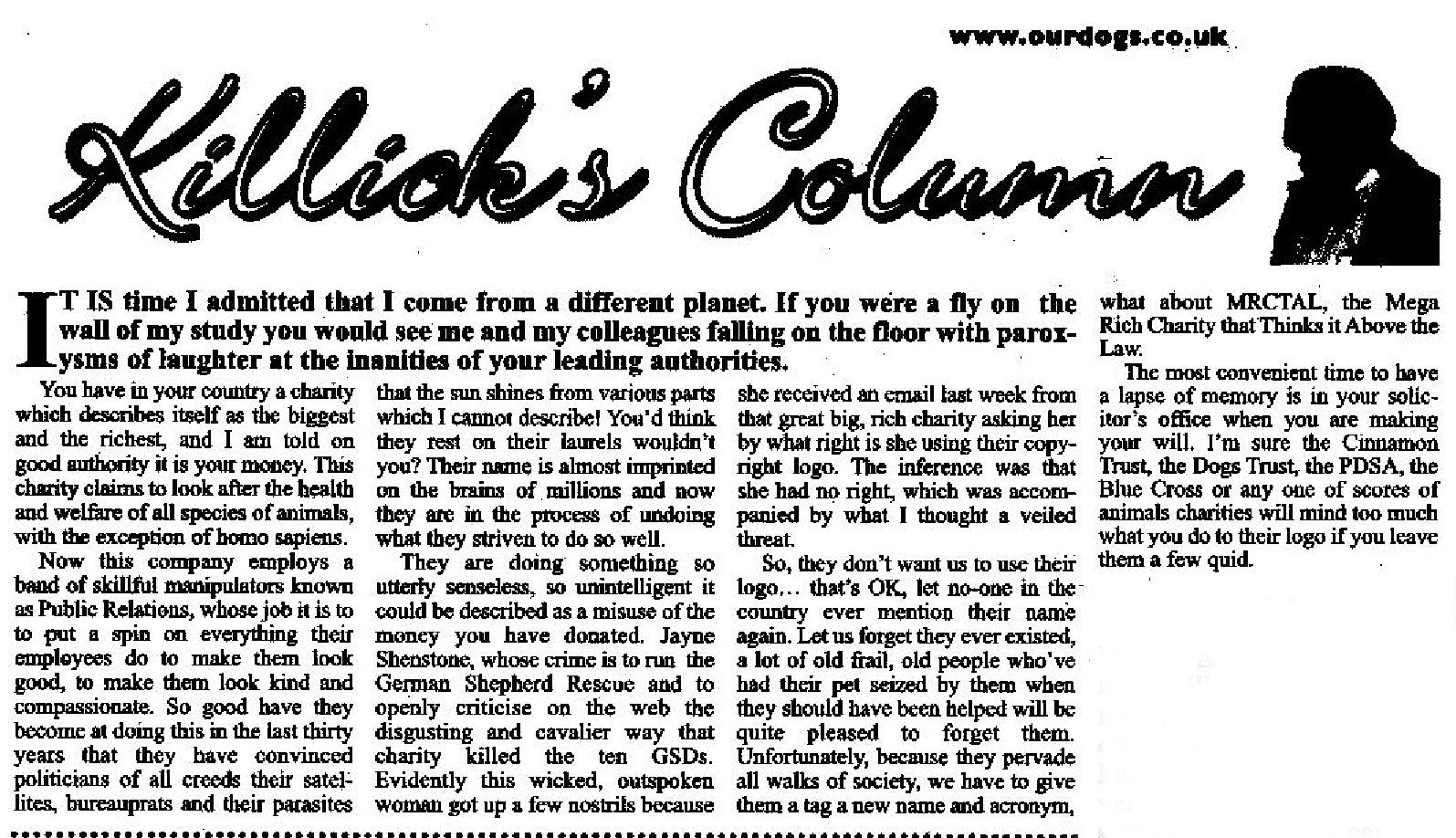
Having written yesterday about the disgusting use of a captive bolt gun by a major animal charity to kill ten GSD I have today come across an indication that the same said charity is using its solicitors to protect its trademark. Therefore I have removed any mention of this organisation in terms of its protected trademark and have replaced it with MRCTAL, which was suggested by Robert Killick
Monday, 5 April 2010
New dog legislation, more wind and red tape
The issue of dangerous dogs has reared itself again in recent weeks. It appears animals are rightly featuring as an issue in the coming election.
Regardless of party politics I do not think anything that any of the political parties are proposing will really make a difference.
What is necessary is a way of controlling the trash-breeders who breed from their bitches over and over again, selling their puppies at whatever price or dumping them on rescue organisations. These people care little where the puppies go, and rarely take them back if things don't work out.
The principle source of customers for these trash-breeders is the classified ad and the pet shop window. This is what should be stopped first. The only people who should be allowed to advertise the sale of any animal should a person licensed to do so (and the license is already there for reputable dog breeders, though it will need to be toughened up a bit), plus charities and rescue organisations. Dog breeders would be required as many of them already do to involve vets in the care of the bitch, chip the puppies and home check the potential owners. The chipping then becomes more effective as this can be linked to any proposed (though ridiculous) insurance database.
Regardless of party politics I do not think anything that any of the political parties are proposing will really make a difference.
What is necessary is a way of controlling the trash-breeders who breed from their bitches over and over again, selling their puppies at whatever price or dumping them on rescue organisations. These people care little where the puppies go, and rarely take them back if things don't work out.
The principle source of customers for these trash-breeders is the classified ad and the pet shop window. This is what should be stopped first. The only people who should be allowed to advertise the sale of any animal should a person licensed to do so (and the license is already there for reputable dog breeders, though it will need to be toughened up a bit), plus charities and rescue organisations. Dog breeders would be required as many of them already do to involve vets in the care of the bitch, chip the puppies and home check the potential owners. The chipping then becomes more effective as this can be linked to any proposed (though ridiculous) insurance database.
Stunned by the "MRCTAL"
I have only just come across the story which worries me. As a news junkie I wonder what bubble I must have been living in to miss this story when it originally broke.
Thanks to this Facebook group I found a link to the Many Tears organisation and on there the news of what the MRCTAL had been doing. You read it in their own words here.
As distressing as the story is I wonder why the MRCTAL has got itself into a position where on the one hand it had rehomed 15,872 stray and unwanted dogs, but on the other had to kill 8,313. I know that among that number there would be those cases that truly are beyond help - and I would expect that most of those are for medical reasons. But when 10 dogs are destroyed in such a brutal manner without any consultation with other rescues it seems the charity has lost its point of being.
Thankfully we are a small charity but we have already experienced a difficult dog. A dog that has displayed aggression and fear and who is requiring intensive therapy and training to get him used to the sights and sounds that had been denied him previously. It is thanks to our dedicated volunteer Donna who has been working with him to get him on the road to recovery. It would sound to me that those 10 GSD's needed similar treatment. Every dog deserves a second chance.
Thanks to this Facebook group I found a link to the Many Tears organisation and on there the news of what the MRCTAL had been doing. You read it in their own words here.
As distressing as the story is I wonder why the MRCTAL has got itself into a position where on the one hand it had rehomed 15,872 stray and unwanted dogs, but on the other had to kill 8,313. I know that among that number there would be those cases that truly are beyond help - and I would expect that most of those are for medical reasons. But when 10 dogs are destroyed in such a brutal manner without any consultation with other rescues it seems the charity has lost its point of being.
Thankfully we are a small charity but we have already experienced a difficult dog. A dog that has displayed aggression and fear and who is requiring intensive therapy and training to get him used to the sights and sounds that had been denied him previously. It is thanks to our dedicated volunteer Donna who has been working with him to get him on the road to recovery. It would sound to me that those 10 GSD's needed similar treatment. Every dog deserves a second chance.
A lot has happened
The charity is now official! The Charity Commission granted registration. The charity has completed its first accounting period (31 March) and as I write the accounts have been closed and sent to an accountant. We have rehomed 12 dogs in the last six months, a small number but we're a small organisation. We've only just started. We have nine in our care at the moment and a long list of people needing our help. We know that the only way we can deliver benefit to the public is to increase fundraising and to this end a second charity shop should hopefully be opening in the next couple of months.
I have devised a strategic plan to fundraising for the next three years which will rely on activities to generate funds until we are established to the point where general donations and legacies become more substantial. The latter form of income is by far the most efficient for a charity because the costs to generate these incomes is minimal. AGF income on the other costs money, though of course provided it is profitable it has much more to offer than just money. It is often a focal point to publicise the dogs and the objects of the charity - to advertise events and request help from volunteers.
I have devised a strategic plan to fundraising for the next three years which will rely on activities to generate funds until we are established to the point where general donations and legacies become more substantial. The latter form of income is by far the most efficient for a charity because the costs to generate these incomes is minimal. AGF income on the other costs money, though of course provided it is profitable it has much more to offer than just money. It is often a focal point to publicise the dogs and the objects of the charity - to advertise events and request help from volunteers.
Monday, 29 March 2010
PAYE End of Year return done
Well that was easy. The HMRC CD-ROM is so easy to use - though having to install the 2010 disk over the 2009 disk just to get to the End of Year bit was a little bizarre. In fact it was so easy it made me a little uneasy - as if I had forgotten something. I think I will give it a few days then ring HMRC just to double-check everything is okay. Thankfully we only have two employees - a shop manager and assistant manager, as I think the HMRC CD-ROM is limited to a small number of employees.
Alverley Car Boot 2010
What a success our first car boot at Alverley has proved to be. A bigger site allowed for a good number of booters and buyers. The day also proved useful in another way in that has provided us with a potential source of income through the Utility Warehouse. Mark was approached by a representative and we will be exploring this in more detail to see what benefit the charity can make from this association.
Subscribe to:
Posts (Atom)